

Our new paper in Journal of Energy Stroage (IF:10.7) "Binder Engineering for Prelithiated SiOx Anodes in Lithium-Ion Batteries"
- May 17
- 1 min read
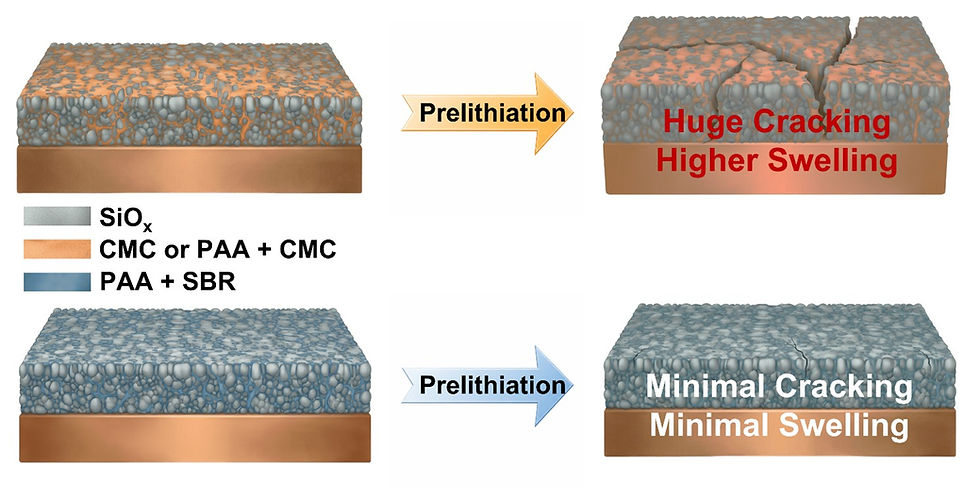
Silicon monoxide (SiOx) is a promising anode material for lithium-ion batteries owing to its high theoretical capacity, yet its application is limited by low initial Coulombic efficiency (ICE) caused by irreversible lithium consumption. Prelithiation is an effective strategy to address this issue, although the influence of binder chemistry during prelithiation has not been systematically clarified. In this work, the effects of binder formulation and prelithiation strategy on SiOx anodes are investigated by comparing five binder systems under direct-contact prelithiation (DCP) and chemical prelithiation (CP). Electrochemical results show that binder engineering strongly impacts lithiation efficiency, reversible capacity, and cycling stability. Among all systems, electrodes employing the PAA+SBR binder consistently deliver the best performance, achieving high ICE (>95%), high reversible capacity (up to ~1900 mAh g−1), and stable capacity retention over extended cycling under both DCP and CP. Morphological and interfacial analyses reveal that PAA+SBR effectively suppresses electrode cracking, limits thickness expansion, and maintains low interfacial impedance. X-ray photoelectron spectroscopy further indicates that PAA+SBR forms a relatively thinner, inorganic-rich interphase dominated by Li2CO3 and Li2O, in contrast to the organic and silicate-rich interphase observed for PAA+CMC. These findings demonstrate that binder engineering plays a critical role in enabling high-performance prelithiated SiOx anodes.


Comments